
The audit that doesn’t stop the project — it improves it.
Structured micro-reviews based on PMBOK standards and Agile Scrum principles, designed to detect deviations early — without bureaucracy or disrupting execution. A methodology that turns every finding into real, actionable improvement.
Practical Guide to Micro- Audits
How to ensure the technical and documental management of your project without creating bureaucracy or slowing down construction progress.
**Includes: PMBOK methodologies, Scrum & Agile approaches, and Construction Project Management principles.
The Problem
What happens when there is no clear audit process in place.
Projects wait until the final closeout phase to review performance — and by then, deviations have already turned into losses in time, budget, and reputation.
Findings are neither documented nor classified — and without classification, there is no corrective action. The same mistakes are repeated from one project to the next.
Document control loses alignment with actual execution: what is shown on paper no longer reflects what is happening on site.
Audits are perceived as bureaucracy or policing, causing teams to become defensive and stripping the process of its true value as a tool for continuous improvement.
An audit without a clear process does not improve the project — it only documents what has already been lost.
And almost always, that cost is far greater than it should have been.

Who is this for?
For professionals who lead and manage construction projects.

Project Manager
You need to maintain control over technical and document management without disrupting operations — using an agile method your team can easily understand and adopt.

Site Engineer / Construction Inspector
You need traceable evidence, properly classified findings, and a review process that works in the field without complicating day-to-day operations.

Project Director / CEO
You need your teams to audit with clear criteria, document with structure, and turn results into sustainable improvements — not reports that no one reads.
If auditing in your projects feels like a burden instead of a management tool, this book is for you.
What’s Included?
The complete micro-audit cycle in one practical resource.
📄Complete PDF Guide
A practical guide covering the 7 stages of the micro-audit cycle: why auditing matters, PMBOK foundations, Agile Scrum approach, preparation, execution, analysis, and continuous improvement. Includes real construction-site examples.

🗂 7 field-ready annexes you can apply from day one.
Audit Plan Template · Technical & Document Control Checklist · Findings Log · Rapid Interview Template · Executive Report Format · Continuous Improvement Matrix · Quick Guide for CEOs and Project Directors.
Everything you need to professionalize the audit process in your projects — in one practical, ready-to-use resource.
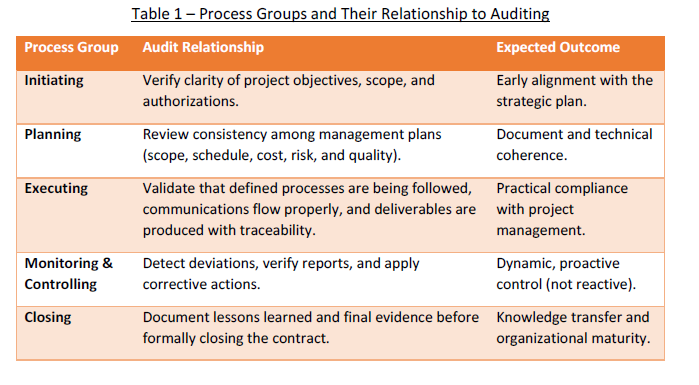
Real Tools Included in the Guide
A quick-reference table showing how each PMBOK process group — Initiating, Planning, Executing, Monitoring & Controlling, and Closing — directly connects to the audit process and the expected outcome from each stage.
Included in a print-ready format for on-site use.

CONTENTS
From preparation to closeout — with every step fully covered.
01 — Why Audit During Execution Instead of Only at Closeout
What a micro-audit is, how it differs from standard control processes, the benefits of applying it early, and typical on-site situations where it adds value.
02 — PMBOK Foundations
Connection with PMBOK process groups, the most critical knowledge areas in construction projects, and an audit structure aligned with PMBOK principles.
03 — Agile Approach: Integrating Scrum Without Losing the PMBOK Foundation
Which Scrum practices are compatible, how to streamline audits without creating bureaucracy, and an example of a “technical + document sprint review” audit approach.
04 — Preparing the Micro-Audit
Defining objectives and scope, participant roles, audit planning, PMBOK-based criteria, and pre-audit communication with the team.
05 — Step-by-Step Execution
Document review, on-site verification, rapid team interviews, findings documentation, and assertive communication during the audit process.
06 — Results Analysis and Action Plan
Findings classification, root cause analysis, action plans with responsible parties and deadlines, follow-up indicators, and audit cycle closure.
07 — Continuous Improvement and Audit Culture
How to institutionalize micro-audits, maturity indicators, applying the Deming Cycle, and maintaining a people-centered approach throughout the process.
7 Annexes with field-ready templates
Audit Plan · Technical Checklist · Findings Log · Interview Template · Executive Report · Continuous Improvement Matrix · Quick Guide for Directors.
Frequently Asked Questions
Before You Decide

Have any other questions? Contact me at info@acprojectspm.com
WHAT PROFESSIONALS SAY AFTER APPLYING IT
Real results from professionals & companies.
Finally, I understood that an audit does not begin when you step into the field — it starts long before that. This guide completely changed the way I prepare and execute project reviews.
Arq. D. Rosas
Auditing had always been a headache for us. With this method, my teams now review with clear criteria, document in an organized way, and close findings without leaving unresolved conflicts behind.
PM - A. HERRERA
Start auditing with a method — not with improvisation.
PDF Guide + 7 field-ready annexes.
Instant download available immediately after payment.
$21.99
One-time payment · No subscription · Permanent access
Secure payment PayPal.
If the guide does not deliver on what it promises, contact me directly at info@acprojectspm.com and we will resolve it.
My reputation depends on this truly working for you.
© 2026 AC Projects PM · Ing. Anynka Carvajal www.acprojectspm.com